Out of the thousands of DOS releases, the ones still alive are those whose mechanics never depended on the graphics: an exact jump, an honest shot, a turn taken in order. Eleven of them are below, sorted by genre, each with a link that starts it in the browser and an honest line about where it has aged. Everything here opens from the retro games section with nothing to install.
If picking feels like work, start with Doom and Dune II. Those two cover both halves of the era.
On this page
Short answer
- First run: Doom — understandable in a minute, runs on any machine.
- Mouse and planning: Dune II, the game the whole real-time strategy genre copied.
- Precision and patience: Prince of Persia, where a jump carries the weight a shot carries in a shooter.
- Twenty minutes flat: Tyrian 2000, Lemmings, Epic Pinball.
- Aged worst: DOS ports of arcade fighting games, and anything that expected a ten-page manual on the desk.
Shooters: where the third dimension started
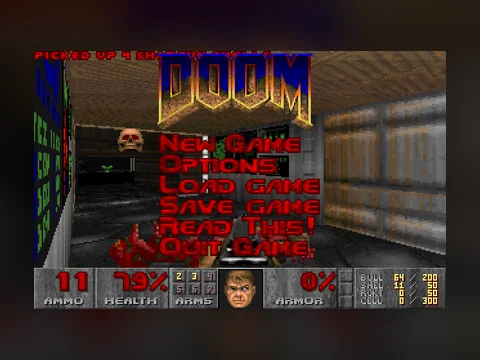
Doom
Year: 1993 · Studio: id Software Controls: keyboard · Play: episode one in the browser
The game that sold the idea of speed. Corridors are tight, monsters are visible immediately, weapons hit instantly, and the whole tactic is to keep moving so nothing surrounds you. The levels, meanwhile, are key-and-switch puzzles, which surprises anyone expecting a shooting gallery.
Where it misses: there is no vertical aim, the shareware config ships with the mouse off, and if you come from modern shooters your hands will spend five minutes on the wrong keys. Controls and secrets are unpacked in the episode one guide.
Wolfenstein 3D
Year: 1992 · Publisher: Apogee Controls: keyboard · Play: episode one in the browser
A year before Doom this looked like a miracle: castle corridors, hidden doors, a score for the secrets you found printed at the end of every level. It still plays briskly precisely because of those secrets — here you tap walls with the space bar out of habit.
Where it misses: every floor is at one height and the map is flat, so the sameness arrives sooner than it does in Doom.
Duke Nukem 3D
Year: 1996 · Engine: Build Controls: keyboard and mouse · Play: in the browser
The interesting part is not the hero but the level: working lifts, cinemas, mirrors, vents you can crawl through to flank. The first shooter where a place looked like a place instead of a set of rooms.
Where it misses: 1996 humour sounds like 1996 humour in places. It is also the heaviest of the three on a weak machine.
Strategy: the three games that wrote the rules
Dune II
Year: 1992 · Studio: Westwood Studios Controls: mouse · Play: in the browser
Everything starts here: build a base, harvest a resource, select a unit with the mouse, click a target. The three houses — Atreides, Harkonnen and Ordos — play differently, and that became a standard too.
Where it misses: units are selected one at a time, with no box select. That is the loudest difference from every strategy game released afterwards.
Command & Conquer
Year: 1995 · Studio: Westwood Studios Controls: mouse · Play: publisher demo in the browser
Everything Dune II lacked: group selection, a legible economy, briefings shot with live actors. The pace is noticeably higher, and a match stops being unit-by-unit bookkeeping.
Where it misses: what we host is the free demo the publisher released, so it is a handful of missions rather than the campaign.
Sid Meier's Civilization
Year: 1991 · Controls: mouse and keyboard Play: in the browser
Turn-based, and therefore the only entry here that asks nothing of your reflexes. One settler in 4000 BC, then turns, and somewhere in those turns an evening disappears.
Where it misses: that length is exactly why the browser is awkward for it — progress does not survive a page reload, and a game lasts longer than one sitting. The reason is explained in how these games run in a browser.

Platformers and cinema at 320×200
Prince of Persia
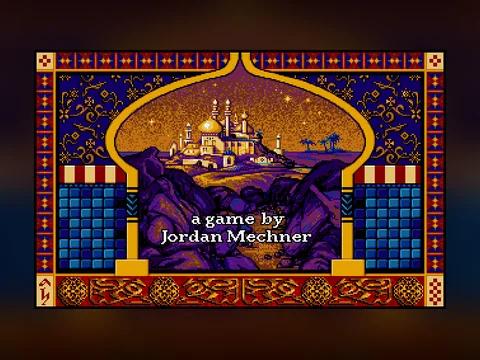
Year: 1989, DOS port 1990 · Author: Jordan Mechner Controls: keyboard · Play: in the browser
The prince's movement was traced from film: Mechner shot his younger brother running and jumping, and rotoscoped the sword fighting from the duel in The Adventures of Robin Hood. Hence the weight of every step — and the one-hour limit the story gives you.
Where it misses: movement carries momentum, and the first deaths will feel unfair. This is not a broken platformer, it is a different one.
Another World
Year: 1991 · Author: Éric Chahi Controls: keyboard · Play: in the browser
No interface, no text, no tutorial: the game explains itself through what happens on screen. Polygons instead of sprites, which is why the picture has barely aged.
Where it misses: it is short and merciless, and one hit kills. An evening, if you do not count the retries.
What can I play in twenty minutes?
Tyrian 2000
Year: 1995, the 2000 edition 1999 · Genre: vertical shooter Play: in the browser
Made by Eclipse Software, published by Epic MegaGames, and released into free circulation in 2004. There is a shop between levels, and half the pleasure is assembling a ship that suits how you fly.
Where it misses: the story interludes carry surprisingly much text for a shoot-em-up, though they can be skipped.
Lemmings
Year: 1991 · Genre: puzzle · Controls: mouse Play: in the browser
You cannot steer the creatures, only hand out jobs: dig, build, block the road. Early levels take a minute, later ones are engineering problems.
Where it misses: small targets and precise clicking, which makes it painful on a phone.
Epic Pinball
Year: 1993 · Genre: pinball · Controls: two shift keys Play: in the browser
The ideal twenty-minute format: two keys, a table drawn pixel by pixel, tracker music. Nothing to learn.
Where it misses: the shareware release has one table. For different physics, Pinball Fantasies sits next door.

What has aged badly enough to skip?
DOS ports of arcade fighters. Mortal Kombat and Street Fighter II run slower on a PC than they did in the cabinet, and six buttons per player sit badly on one keyboard. Fine as an exhibit, poor as an evening.
Anything that shipped with a thick manual. Space simulators and part of the strategy catalogue honestly assumed a hundred-page book on the desk. Without it you will spend longer reading the interface than playing.
Long-haul campaigns. Civilization and Master of Orion are excellent and run straight into the save problem: reload the page and the game starts over.
Network co-op. The shareware archives still contain the IPX and modem utilities. In a browser they do nothing, because there is no network between tabs.
Publisher demos, if you came for the campaign. Some titles in the section are free demos rather than shareware episodes — Command & Conquer and Theme Hospital among them. The mechanics are complete, but the campaign stops where the publisher cut it.
What usually goes wrong
Expecting graphics, meeting rules. Symptom: the game is open for a minute and closed. Cause: the least interesting part of a DOS game is the first thing you see. Fix: give it five minutes and reach the first key or the first shop. The design starts there.
Opening the heaviest title first. Symptom: stutter, crackling sound. Cause: Quake and Duke Nukem 3D need much more than a platformer does. Fix: start light, go fullscreen, close spare tabs.
Choosing Ultra-Violence because it sounds better. Symptom: death on level one and a sense that the game is broken. Cause: difficulty in these shooters changes the number of enemies, not the damage numbers. Fix: take a lower skill, that is what it is for.
Looking for autosave. Symptom: half an episode done, the tab refreshes, everything is gone. Cause: the emulator file system lives in the tab's memory. Fix: save inside the game and do not reload the page.
Playing mouse games on a phone. Symptom: in Lemmings you cannot hit a single lemming. Cause: the game expects an exact cursor. Fix: pick thumb-friendly genres, which is the subject of the retro games on a phone guide.
Where to go next
This is an entrance rather than a catalogue: the section holds fifty games, and half of them are missing here only because a list of eleven can be read and a list of fifty cannot. To let chance choose, there is the random game picker; to build your own ranking of the classics, there is the tier list maker and a guide on making such a list honest.
FAQ
Which game should I open first if I know nothing about DOS?
Doom. It explains itself in a minute, runs on anything and shows immediately why these games are still around. Dune II is the natural second pick, because it represents the other half of the era — mouse driven and planned rather than fast.
Are old games really harder than modern ones?
They are different rather than harder. There are no hints, no waypoint and no autosave, but almost all of them ship with difficulty settings and a one-life price for mistakes. Choosing the easier skill in Doom or Wolfenstein 3D answers half the complaints.
What can two people play at one keyboard?
Turn-based artillery such as Scorched Earth and Super Worms: one keyboard, one minute of rules. DOS fighting games are a worse choice for this — six buttons per player, and the ports run slower than the arcade originals.
Why do so many DOS games end halfway through?
That is the shareware model. The first episode was given away and the rest were sold by mail, so the game reaches the end of episode one and offers to sell you the sequel. It is not a bug or a trimmed build.
Do I need a mouse or a joystick for these?
Strategy, puzzle and pinball titles need a mouse; the shooters and platformers of the era are keyboard games, and Doom ships with the mouse switched off in its config. Gamepads are not wired up in our player, so do not plan around one.
Sources
- Wikipedia: Doom (10 December 1993, shareware release, source under GPL in 1999)
- Wikipedia: Dune II (December 1992, Westwood, the template for real-time strategy)
- Wikipedia: Prince of Persia (1989, rotoscoping, MS-DOS port April 1990)
- Wikipedia: Tyrian (1995, Eclipse Software and Epic MegaGames, freeware in 2004)
- Internet Archive: MS-DOS games software library