How to use
- Put your teams or players in the box, one per line. Anything from 2 to 64 lines works; empty lines are ignored.
- Leave Random seeding ticked for a fair draw, or untick it to keep your own order — see the seeding section below for what that order does.
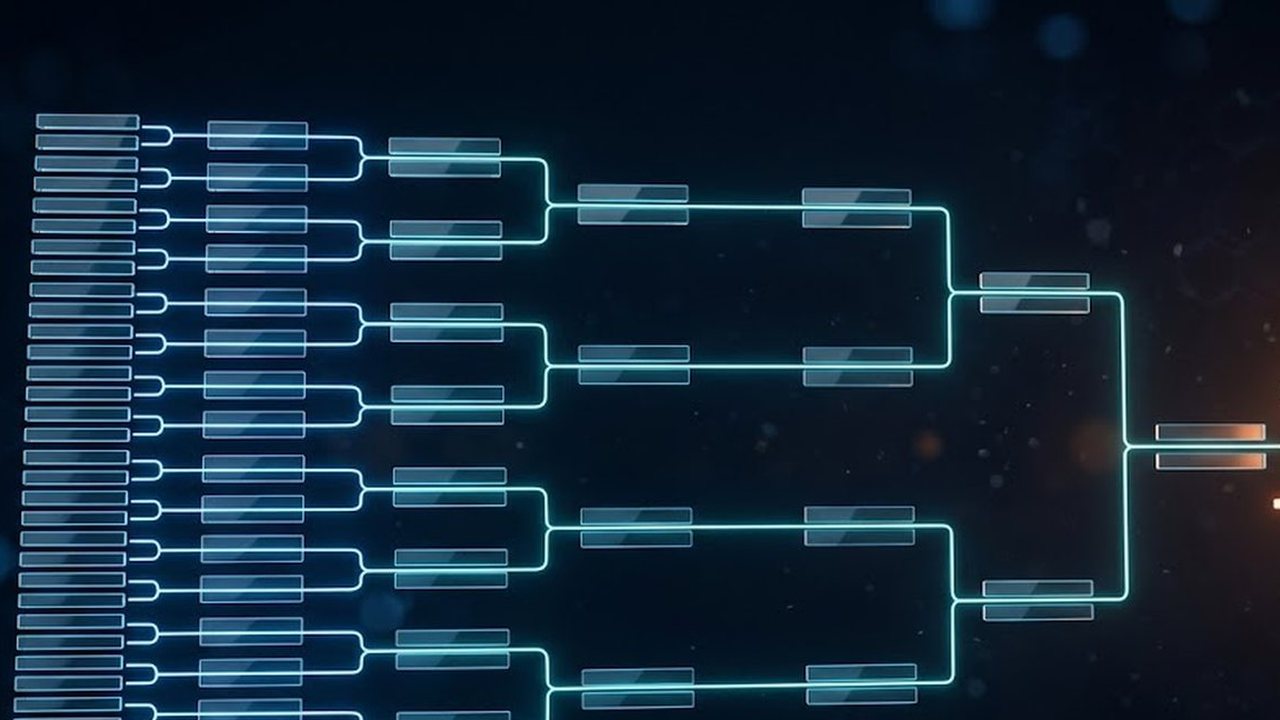
- Press Build bracket. The rounds appear side by side, labelled
Round 1,Quarterfinals,SemifinalsandFinal, and byes are already advanced. - As matches finish, click the winner's name in the match. It turns green and drops into the next round; the trophy line shows the champion once the final is decided.
- Clicked the wrong name? Click the other one in the same match — later rounds that no longer make sense are cleared automatically. Copy bracket puts the whole thing on your clipboard as text for Discord.
Bracket size, byes and the number of matches
A single-elimination bracket always rounds up to a power of two. Eleven teams go into a 16-slot bracket, and the five empty slots become byes — free passes into round two. The number of matches, on the other hand, never depends on the bracket size: every match eliminates exactly one team, so N teams always play N−1 matches.
| Teams | Bracket size | Byes | Rounds | Matches played |
|---|---|---|---|---|
| 2 | 2 | 0 | 1 | 1 |
| 4 | 4 | 0 | 2 | 3 |
| 5 | 8 | 3 | 3 | 4 |
| 6 | 8 | 2 | 3 | 5 |
| 8 | 8 | 0 | 3 | 7 |
| 12 | 16 | 4 | 4 | 11 |
| 16 | 16 | 0 | 4 | 15 |
| 24 | 32 | 8 | 5 | 23 |
| 32 | 32 | 0 | 5 | 31 |
| 64 | 64 | 0 | 6 | 63 |
Byes go to the top lines of your list, so with random seeding on they land on random teams, and with it off you decide who gets the free pass. A bye is a real advantage — the team skips a match — which is why organisers usually hand them to the highest seeds or draw for them in public.
Seeding: random draw or your own order
With Random seeding ticked, the list is shuffled first (same cryptographic shuffle used by the rest of our randomizers), then paired. That is the right setting for a community cup where nobody has a ranking yet, and it is the setting that keeps arguments out of the draw.
Untick it and the pairing follows your list exactly: the first line meets the last line, the second meets the second-to-last, and so on. With eight teams that gives 1–8, 2–7, 3–6, 4–5, which is the classic "strongest against weakest" first round.
One detail worth knowing before you rely on it: neighbouring matches meet in the next round. So lines 1 and 2 of your list would collide in the semifinal, not the final. If you want your two strongest teams to meet only in the final, put the second-strongest in the middle of the list — the fourth line in an eight-team bracket, the eighth line in a sixteen-team one. Or just leave random seeding on and let the draw decide.
Running an evening tournament in CS2, Valorant or Free Fire
The bracket takes a minute. What actually decides whether the event finishes is how long one match lasts multiplied by the number of rounds — matches inside a round run in parallel if you have enough servers or rooms.
| Format | Usual length of one match | 8 teams (3 rounds) | 16 teams (4 rounds) |
|---|---|---|---|
| CS2, bo1 to 13 rounds (MR12) | about 35–50 min | roughly 2–2.5 hours | roughly 3–3.5 hours |
| Valorant, bo1 to 13 rounds | about 35–50 min | roughly 2–2.5 hours | roughly 3–3.5 hours |
| Free Fire, Clash Squad best of 7 | about 10–15 min | under an hour | about an hour |
| Brawl Stars, friendly 3v3 bo3 | about 10 min | under an hour | about an hour |
| School / class knockout, any short game | 5–10 min | 30–45 min | about an hour |
Times are rough and depend on skill level, overtime and how long the lobby takes to fill; treat them as planning numbers, not promises. Three practical rules from small cups: run every round as a best-of-one except the final, keep a five-minute buffer between rounds for screenshots and disputes, and post the updated bracket after each round so nobody has to ask who they play next. The Copy bracket button gives you the text list of every round for exactly that.
When the team count is awkward
Five, six, eleven, thirteen — real sign-ups rarely land on a power of two. Three ways to deal with it, all of which work with this tool:
- Let it give byes. Simplest option: build the bracket and the extra slots become free passes. Fair as long as the byes are drawn randomly or announced in advance.
- Play a qualifier first. With 11 teams, play three qualifier matches between the six lowest-ranked entries, then paste the remaining eight names and build a clean bracket with no byes at all.
- Add a filler entry. If someone can play twice or a coach can stand in, an extra line removes a bye and gives everyone a real first-round match.
For an odd number of players in a school class, the bye approach is usually the calmest: build with random seeding, show the screen, and the free pass is visibly not a favour to anyone.
The five rules to announce before the first match
Almost every argument in a small cup is about something nobody wrote down. The bracket is the easy part; post these lines next to it and the evening runs itself.
| What to announce | A workable default |
|---|---|
| Format per round | Best of one until the final, best of three in the final |
| How the map is chosen | The in-game veto, or the higher line in the bracket picks |
| Roster lock | Whoever plays round one plays the whole cup; one stand-in only if both captains agree |
| No-show timer | Ten minutes after the round is posted, then the opponent advances |
| Proof of result | The winner posts a screenshot of the final scoreboard in the channel |
Two more things are worth deciding while nothing is at stake. Name one admin whose word settles disputes, and say in advance what happens to a match interrupted by a disconnect — replay the round, replay the map, or count it as it stood. Rules invented in the middle of a semifinal are the ones players remember a year later.
If a prize is involved, write down how it is split before sign-ups close. A cup that ends in a spreadsheet argument is remembered as a bad cup, however clean the bracket looked.
What makes ours different
- Up to 64 entries, byes and rounds calculated for you, with no account or sign-up.
- Cryptographically random seeding — the same rejection-sampled shuffle as our other randomizers, not a rough
Math.random()sort. - Clickable winners with automatic correction: change an early result and the impossible later rounds clear themselves.
- Copy bracket exports every round as plain text, ready to paste into a Discord channel or a chat.
- Works on a phone — the bracket scrolls sideways, so you can run the cup from the same device you play on.
What it is not: this is a single-elimination bracket only. There is no double elimination, no group stage, no round robin, no score entry and no login, so nothing is saved — pressing Build bracket again starts a fresh draw, and reloading the page clears the results. Copy the text after each round if you need a record.
Privacy
The bracket is built and updated entirely in your browser. Team names, seeding and results are never sent to a server, nothing is stored, and no one else can open your bracket by link. That also means the tab is your only copy — press Copy bracket to save the state before you close it.
FAQ
How many teams can the bracket hold?
From 2 to 64 lines. Anything that is not a power of two is rounded up to the next bracket size (8, 16, 32, 64) and the empty slots become byes into the second round.
How do byes work?
Empty slots are paired with the top lines of your list, and those entries are advanced automatically before you click anything. With random seeding on, that means the byes fall on random teams.
Can I set the seeding myself?
Yes — untick Random seeding and the list order is used as is: first line versus last, second versus second-to-last. Remember that neighbouring matches meet in the next round, so put your second-strongest team in the middle of the list to keep the top two apart until the final.
How do I record a result?
Click the winner's name inside the match. It is highlighted and copied into the next round. Clicking the other name instead fixes a mistake and clears any later rounds that no longer make sense.
Can I save the bracket or share a link to it?
There is no saving and no share link — everything lives in the open page. Use Copy bracket to put all rounds on your clipboard as text and paste it wherever your players are, then update the message after each round.
Does it support double elimination or group stages?
No. This is a single-elimination bracket only: one loss and you are out. For a group stage, run the groups separately and paste the qualified teams here for the playoffs.
Is the random seeding actually random?
Yes. It uses the same crypto-based shuffle as the rest of the randomizers on this site — crypto.getRandomValues() with rejection sampling — so every draw order is equally likely.