Almost every home-made tournament dies the same way: it is still running at 1am with four teams left and half the players gone to bed. The fix is arithmetic done before the invites go out. Count how many matches your chosen format actually produces, multiply by how long one match takes, divide by how many can run at the same time — and only then decide on the format. Then write one page of rules, and check whether the game's publisher requires anything from you, because for Valve games it does.
On this page
Start from the time budget, not from the format
Every format has a fixed match count, and this is the whole planning problem in one table:
| Format | Matches for N entrants | 8 entrants | 16 entrants | Games each entrant is guaranteed |
|---|---|---|---|---|
| Single elimination | N − 1 | 7 | 15 | 1 |
| Double elimination | roughly 2N − 2 | ~14 | ~30 | 2 |
| Round robin | N × (N − 1) / 2 | 28 | 120 | N − 1 |
| Swiss, 5 rounds | about 2.5 × N | ~20 | ~40 | 3 to 5 |
| Group stage + playoff | groups + bracket | ~16 | ~32 | 3 |
Two consequences fall straight out of that. Round robin is wonderful and almost never affordable — 16 entrants is 120 matches. And single elimination is cheap precisely because it is brutal: half your field plays once, loses, and has nothing to do for the rest of the day.
Matches inside the same round run in parallel if you have the rooms, lobbies or servers for them, so the number that determines the wall-clock length is rounds × match length, not total matches. Eight teams in single elimination is three rounds; at forty minutes a match that is two hours plus the gaps. The same eight teams in a round robin is seven rounds even with four matches at once — most of a day.
Which format for which occasion
Four to eight friends, one evening. Single elimination, best-of-one, plus a third-place match so the losing semi-finalists get one more game. If people will grumble about being knocked out on a fluke, run double elimination instead and accept twice the matches.
A class, a club, 16 to 30 people. Split into teams first, then group stage plus a short playoff. Groups guarantee everyone three games, which is the actual point of a school event — nobody remembers who won, everybody remembers whether they got to play. Keep matches under ten minutes.
An online community cup, unknown skill levels. Swiss. Everyone plays every round, wins meet wins, losses meet losses, and the standings sort themselves out without any pre-existing ranking. Liquipedia's write-up of the format used by Counter-Strike events is a good template: round one is drawn (seeded or random), round two splits the field into winners and losers, from round three on teams meet opponents on the same record that they have not yet played, teams reaching three wins advance and teams reaching three losses are out. Five rounds, and nobody is eliminated in game one.
A group that is one player short of even teams. Fix that before anything else, with a stand-in or a bye — an odd number is where schedules quietly rot.
Seeding and byes
Seeding decides who meets whom, and it is the part people argue about afterwards, so decide the method in public beforehand.
If nobody has a ranking, draw at random and say so. A published random draw ends the discussion; a draw you made "roughly by feel" starts one.
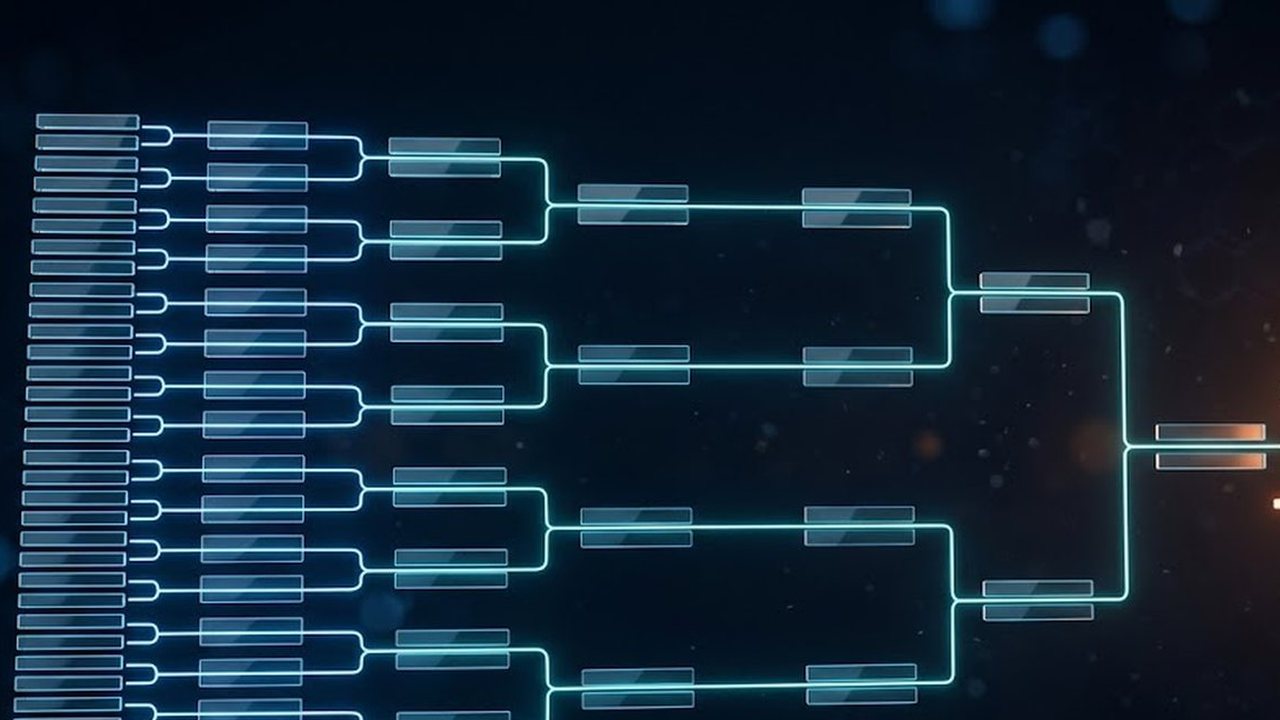
If you do have an order, the classic pairing is strongest against weakest: 1–8, 2–7, 3–6, 4–5. But there is a detail that catches first-time organisers: in a bracket, neighbouring lines meet in the next round. Entries in lines 1 and 2 collide in the semifinal, not the final. If you want your two best entrants to meet only in the final, put the second one in the middle of the list — line 4 of an eight-team bracket, line 8 of a sixteen-team one.
Byes appear whenever your entrant count is not a power of two: eleven teams go into a sixteen-slot bracket and five of them skip round one. A bye is a real advantage, so either give them to the top seeds openly or draw for them in front of everybody.
Our tournament bracket generator does that part: paste 2 to 64 names, leave random seeding on or turn it off to keep your own order, and it builds the single-elimination bracket with byes already advanced. Click a name to send it to the next round, and copy the whole thing as text into Discord as the day goes on. It is single elimination only — for a losers bracket you will need to track a second bracket yourself.
If you also need to build the teams rather than just the bracket, the random team generator splits a pasted list into 2–16 sides in one click, which settles a class in about thirty seconds. Captains picking players by hand is more fun for the captains and worse for whoever gets picked last; for a school event, random is the kinder default.
Write the rules page first
One page, sent with the invite, before anyone signs up. It does not need legal language — it needs to answer the questions that will otherwise be asked at the worst moment:
- Game, patch and mode. Which version, which map or mode pool, and whether anything is banned.
- Match length. Best-of-one in the early rounds and best-of-three in the final is the usual compromise between fairness and finishing.
- Check-in and no-show. A time to be in the lobby, and a stated grace period — many community cups use ten or fifteen minutes before a forfeit. Pick a number and publish it; the exact number matters far less than having one.
- Substitutes. Are they allowed, how many, do they have to be registered before the start.
- Disconnects and pauses. Who may pause, for how long, and what happens if someone drops in round two of twelve.
- Disputes. Screenshots of the final score are the standard evidence. Say who decides, and that their decision ends it.
- Reporting results. One channel, one format, one person responsible. Results shouted across a voice call get lost.
- Conduct. One sentence is enough, and it gives you the ground to remove someone.
Two things belong in that page for their own sake. Say explicitly that skill decides the winners — Supercell puts this in their guidelines in exactly those words, banning match-fixing "and similar shady activities" — and say what happens to the prizes if the event does not finish.
The permissions nobody expects
This is the part that surprises people, and it costs nothing to get right.
Valve games. Valve's tournament page states that all tournaments where Valve games are played require you to complete and agree to the Limited Game Tournament License Agreement, and that neither the retail licences nor the Steam Subscriber Agreement allow a licensee to host a tournament. The agreement is free, the application is a signup form, and it covers Dota 2, Counter-Strike 2, Team Fortress 2 and the rest of Valve's multiplayer catalogue. Valve also notes two limits worth knowing: it cannot license third-party games sold on Steam — for those you ask the publisher — and it does not hand out tournament accounts, so every participant needs their own copy.
VALORANT. Riot's NA Community Competition Guidelines split events into small, medium and major. A small tournament needs no application at all: you are granted a community licence by following the guidelines. In exchange there are real constraints — the prize pool may not exceed $10,000 (or $12,000 in non-cash prizes), you may use the name VALORANT but not the words "Championship", "Champions", "Season" or "League" in your event's name, you may not use Riot logos, and you must display the notice "This competition is not affiliated with or sponsored by Riot Games, Inc. or VALORANT Esports." Entry fees are allowed but the money may only cover running costs or go into the prize pool, and you may not charge spectators to watch online. Regional guidelines differ, so read the one for your region.
Supercell games. Supercell's tournament guidelines are shorter and stricter on one point: all tournaments must be free to enter for the players, no exceptions. Prizes across the event may total up to €50,000, participants need to be at least 13 for cash prizes, and if your event fits inside the guidelines you need no licence or other permission — you only write to them when it does not.
For anything else, look for the publisher's own community-tournament or fan-content page before you announce a prize pool. An evening between eight friends with a chocolate bar as the prize is not what any of these documents are aimed at, but the moment you post a public sign-up form with money attached, they are.
Prizes that work at this scale
For a friends-and-class event, prize design is mostly about not poisoning the mood. Things that work: a small in-game gift card, a physical trophy that stays with the winner until the next event, the right to pick the game for the next session, a printed certificate for the class. Things that go wrong: cash from an entry fee (now you are handling other people's money and the publisher rules above apply), and a winner-takes-all pool in a group where one person is obviously the best player.
Splitting a prize across the top three keeps more people invested past round one, and a "best play of the day" award decided by a vote gives the eliminated half something to stay for.
Running the day
- Confirm attendance the morning of. Every no-show has to be replaced or byed, and doing that live costs twenty minutes.
- Open the lobby thirty minutes early. Someone always needs to install an update.
- Build the bracket in front of everyone and post a screenshot or link. A bracket nobody saw being made is a bracket somebody will question.
- Announce the round schedule, not just the first match. People disappear when they do not know when they are needed.
- Collect results in one place as each match ends, and update the bracket immediately.
- Keep the small decisions random and visible. Who picks the map, who starts on which side, which of two tied teams advances, who gets the leftover prize — put the options into the spin the wheel tool and share the screen. A visible random pick is accepted; the same decision made by the organiser's judgement is argued with.
- Have a plan for stopping. Decide in advance what happens if you run out of evening: play the final and award the rest by seeding, or continue next week. An event that ends deliberately is remembered as an event; one that fizzles out is remembered as a mess.
FAQ
What format should I use for 8 friends?
Single elimination if you have two hours, double elimination if you have four. Single elimination for eight teams is seven matches and three rounds; double elimination is roughly fourteen and guarantees everyone at least two games. A round robin for eight is 28 matches, which is a full day, not an evening.
How many matches are there in a bracket?
In single elimination, always one fewer than the number of entrants, because every match eliminates exactly one of them: 8 teams play 7 matches, 16 teams play 15. Round robin is N×(N−1)/2, which grows fast — 6 teams is 15 matches, 10 teams is 45. Swiss fixes the number of rounds instead, so everyone plays the same number of games no matter how many entrants there are.
Do I need permission to run a tournament?
For Valve games, yes: Valve's tournament page states that all tournaments where Valve games are played require the Limited Game Tournament License, that it is free, and that neither the retail licence nor the Steam Subscriber Agreement allows you to host one. Riot lets small VALORANT events run without an application if they stay inside the community guidelines, and Supercell says no license is needed if your event fits their tournament guidelines.
Can I charge an entry fee?
It depends on the publisher. Riot's community guidelines allow an entry fee for VALORANT events, but the revenue must go only to running costs or into the prize pool. Supercell's guidelines are stricter: all tournaments must be free to enter for players, no exceptions.
How do I seed a bracket fairly?
If nobody has a ranking, draw at random and say publicly that you did — it is the setting that keeps arguments out of the draw. If you do have an order, seed strongest against weakest, and remember that neighbouring lines in a bracket meet in round two, so your second-best entrant belongs in the middle of the list, not in second place.
Sources
- Valve: Game Tournament Licenses (all tournaments with Valve games need the free Limited Game Tournament License)
- Valve: Limited Game Tournament License (full text)
- Riot Games: NA VALORANT Community Competition Guidelines v1.5 (PDF)
- Supercell: Tournament Guidelines
- Liquipedia: Swiss System explained (round-by-round structure used by CS tournaments)